Tuesday, March 3, 2015

Nameless EPP block - Building Blocks Tuesday


EPP project from QuiltCon class with Katy Jones

A swim lesson or two and a few gymnastics classes (for my girls, not me!) and I've finished up the EPP project I started in class with Katy Jones from I'm a Ginger Monkey.  Well, I finished up the EPP part anyway.  Now I need to applique it onto a background, and I think turn it into a pillow????

I am a bit ticked at myself for getting 2 of the pieces mixed up and thus in the wrong spots for coloring purposes.  BUT, I am LAZY and don't want to rip it out.  I think I will just say that "it adds charm" and go with that.  I'm not sure if this block has a name or not.  I trolled through Katy's website and Flickr pool, but didn't come across an actual name, thus "Nameless EPP".

I know some of you might be scratching your heads on why I would take an EPP class in the first place, since I have finished EPP projects in the past.  I think I just wanted a little validation that I was doing it right since I learned all my EPP from the internet and books.  Thankfully, it seems I was on the right track, and I even walked away from the class having learned a different way to baste my pieces.  Katy was a fun teacher, and I really enjoyed the class.  I wish I had taken it on Sunday (the last day of QuiltCon) instead of Saturday, it would have been a nice relaxing class to ease my mind (QuiltCon was a little intense).  Nothing like a little handwork to calm you down, you know?

Don't forget to enter my 500 follower giveaway if you haven't already done so!  You can enter by leaving a comment on this post.  Good luck!

What blocks have you working on this week?  I would love to see.  Link up your fabulous blocks.  You put a lot of hard work into them - show them off!  This free linky will stay open until the first Monday of next month, but I will repost it every Tuesday until a new month starts.


Quilter in the Closet

Rules:

1) Please link up only to the page in your blog showing your wonderful blocks, not just the blog homepage.  Flickr pictures are also OK.
2) Make sure to put your blog name as the description so people know where they are going or the name of your block!
3) Please grab my button and post it in your blog post or sidebar.
4) Visit other linky participants!


Thanks for reading,

Jen


Sunday, March 1, 2015

Inspirational Sunday (4) via the Quilts exhibit at Muzeo 2015

And here is the 2nd post for today.  Finishing up the antique quilt portion of the exhibit at Muzeo in Anaheim, CA.

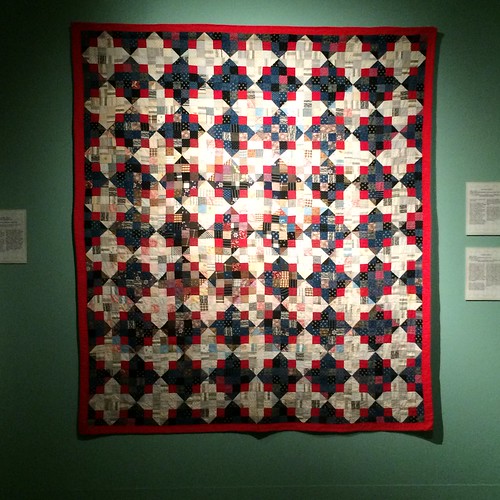
This first quilt is called "Split Nine Patch", maker unknown c. 1890-1940.

Split Nine Patch, maker unknown, c. 1890-1940

The plaque for this quilt challenged viewers to find the repeating unit in the quilt.  Can you see it?  I learned that this pattern was mostly a regional pattern from southeastern Pennsylvania and southern New Jersey.

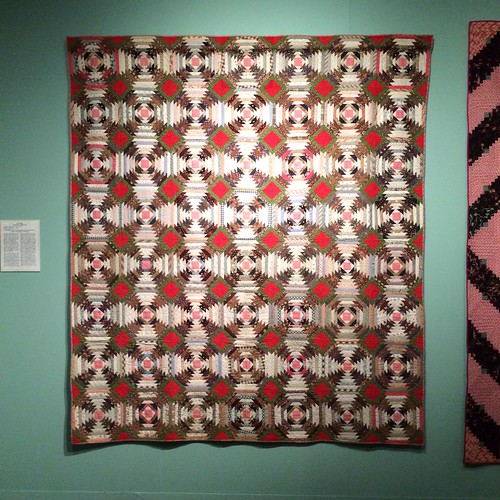
Take a look at this gorgeous quilt!  "Log Cabin, Pineapple Variation" by Anna Hazel Burmeister of Waukesha, Wisconsin c. 1894.

Log Cabin, Pineapple Variation by Anna Hazel Burmeister c. 1894

I would really like to make one of these one day!  Of course, I would paper piece mine!

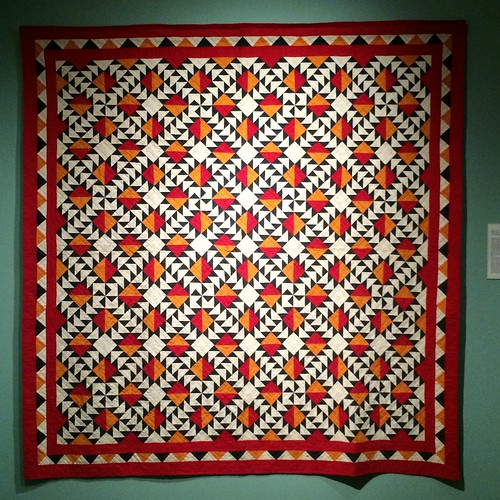
This next quilt looks very modern to me, but was made around 1902 for "Viola", and is called "Wild Goose Chase".

Wild Goose Chase, made for "Viola", c. 1902


This quilt would have been extremely difficult to date because of the solid fabrics used.  Luckily the label inscription helped.  Just another reason why we should all be labeling our quilts, right?

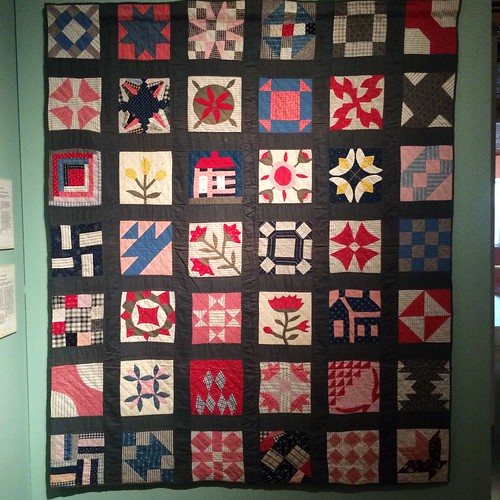
Did you learn to quilt by making a sampler quilt?  This is "Sampler Album", maker unknown c. 1900-1920.

Sampler Album, maker unknown c. 1900-1920


Ok, for this one I want to point out one of the blocks - the Swastika Patch (forth down on left hand side).  Now, I don't want to spark a discussion about Hitler, the KKK, or any modern adoption of this pattern for the logo of discriminating groups.  I am well aware that the symbol evokes strong emotions from many of us.  What I do want to know is, this pattern was very popular prior to WWII, what happened to all the quilts made from this pattern?  They must be somewhere, right?  I never see antique quilts made entirely with this pattern exhibited.  I have several older books with the patterns to make entire quilts with this block, so they must exist.  Or do you think they were destroyed because of what the symbol means to us now?  I am merely curious.  I don't want to start my own collection of Swastika quilts or anything.  It just seems from a historic standpoint, and even an art standpoint that it would be a bit sad if the quilts were all destroyed.  What do you think?

Next week I will finish up my visit to Muzeo by showcasing a few quilts from the modern room of the exhibit.

Thanks for reading,


Jen

Inspirational Sunday (3) via the Quilts exhibit at Muzeo 2015

I am sorry that I forgot to post last Sunday.  My mind was elsewhere while at QuiltCon, so I will post 2 Inspirational Sunday posts today and I will try to wrap up my visit to Muzeo in Anaheim next Sunday.

This post will show you some more of the antique quilts from the exhibit.

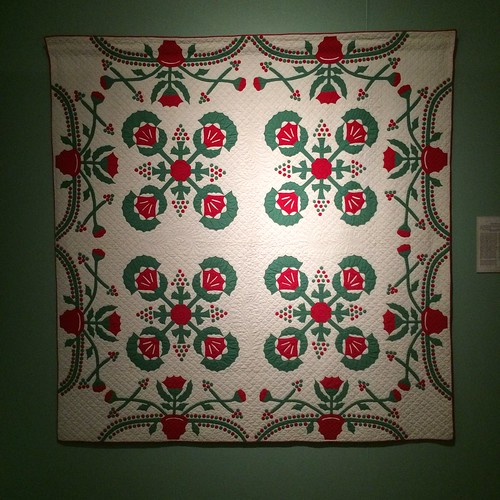
This beauty is called "Coxcomb and Berries" by Cora Arabelle Eckles Dinsmore of New Castle, Pennsylvania c. 1925-1935.

Coxcomb and Berries by Cora Arabelle Eckles Dinsmore c. 1925-1935


All those tiny appliqued circles!

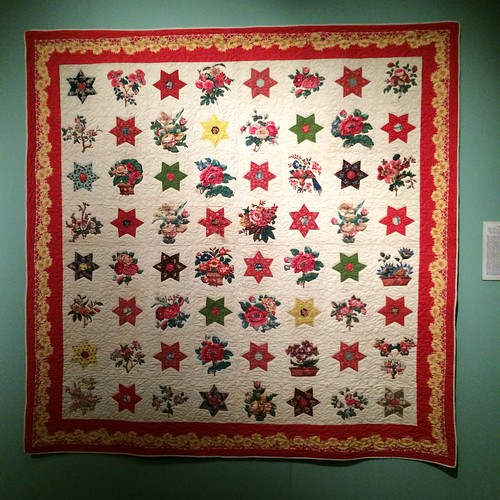
This next one is called "Star and Chintz Album", maker unknown c. 1935-1955.

Star and Chintz Album, maker unknown c. 1935-1955


While viewing this one, I learned about Florence Peto and the Colonial Revival movement.

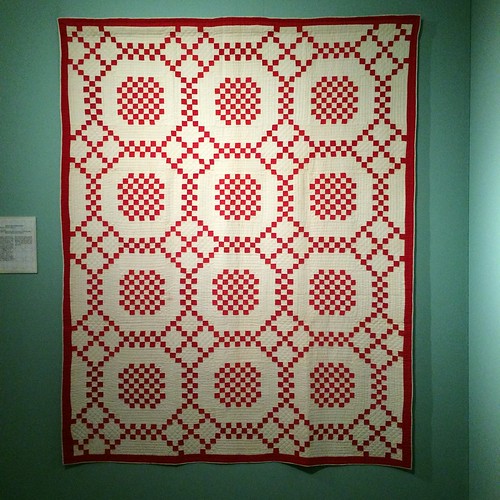
This red and white quilt is called "Burgoyne Surrounded", maker unknown c. 1928.

Burgoyne Surrounded, maker unknown c. 1928


This was another quilt that was influenced by the Colonial Revival, and I was interested to learn that the pattern was influenced by historic weaving patterns of the 1800's.  The name of the pattern commemorates the Battle of Saratoga, when American troops surrounded and captured General Burgoyne's forces.  This particular battle is remembered as an important turning point in the Revolutionary War.

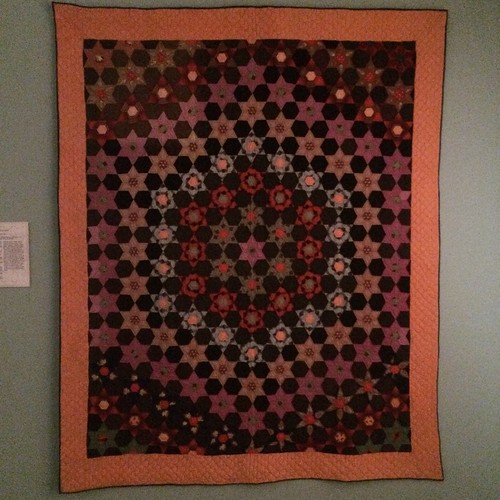
As I've been on a bit of an EPP kick lately, I was delighted to see this "Hexagon Star", maker unknown c. 1860-1880.  I only wish the lighting was better in this part of the museum!

Hexagon Star, maker unknown, c. 1860-1880

I learned that they didn't necessarily call this type of work "English Paper Piecing" back then, rather "Mosaic Patchwork".

I'm not sure an antique quilt exhibit would be complete without a crazy quilt.  This one was titled, "Crazy Quilt" (go figure), maker unknown, dated 1884.

Crazy Quilt, maker unknown, c. 1884


I had no idea that crazy quilts were the result of dissatisfied Americans, fed up with their busy lives in the early 1900's, who were inspired by more relaxed Asian cultures.  The "crazy" format echoed a cracked-ice design common in Chinese and Japanese art.  Cool.

close up of Crazy Quilt, maker unknown, c. 1884


Have you ever wanted to make a crazy quilt?  I have to think it would be a great scrap buster, no?

That's it for this post.  I will be posting another today to finish up the antique portion of the exhibit.


Thanks for reading,


Jen